

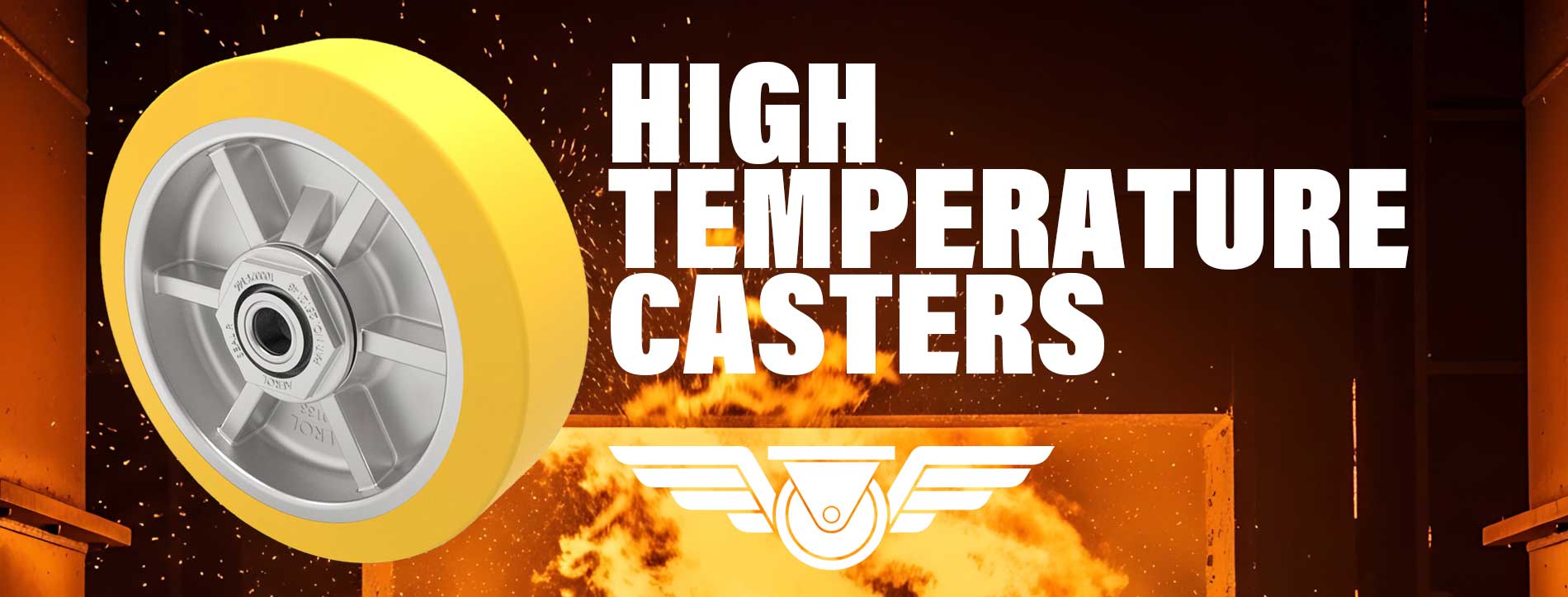
High Temperature Casters: How to Stop Premature Failures in Ovens, Furnaces, and Heat Treat Applications
If you’re replacing casters every few months on equipment near a powder coat oven, autoclave, or heat treat furnace, the problem isn’t how you’re using the casters. It’s that you’re using the wrong casters.
Standard casters aren’t designed for sustained heat. The wheels degrade, the bearings seize, and the swivel locks up — and what should be a durable material handling solution turns into a recurring maintenance cost that adds up fast. IAO Industries supplies high-temperature casters from Caster Concepts, built specifically for extreme heat environments, made to order for your application, and typically shipped in under two weeks.
The Two Most Common High-Temperature Caster Failures
In powder coat ovens, autoclaves, heat treat furnaces, and similar environments, we see the same two failure modes repeatedly:
Wheel degradation. Standard polyurethane and rubber wheels soften, deform, and break down when exposed to sustained heat. Once the wheel material loses structural integrity, load capacity drops, rolling resistance increases, and failure follows quickly. In high-cycle environments — carts moving in and out of ovens repeatedly throughout a shift — this degradation accelerates.
Bearing seizure. Both the wheel bearing and the swivel bearing are vulnerable. Standard grease burns off above 250–300°F, leaving metal-on-metal contact that causes the bearing to seize. A locked wheel bearing turns a rolling caster into a dragging one. A locked swivel bearing means the cart no longer steers. Either failure creates a safety hazard and a maintenance call.
The fix for both is specifying casters built for the temperature range of your specific application from the start.
Matching the Caster to Your Temperature Range
The three most common high-temperature applications we see are powder coat ovens, autoclaves, and heat treat furnaces — most operating in the 350–450°F range. We also supply casters for applications up to 800°F and, in specialized cases, up to 1,100°F. The correct caster specification depends on your actual operating temperature.
350–450°F (Powder coat ovens, paint curing lines, autoclaves):
Cast iron wheels are the standard in this range. Hard, heat-resistant, and unaffected by sustained exposure to curing temperatures. High-temperature rated bearings with grease formulated for this range are essential — standard grease will not survive. This is the most common configuration we supply and the one with the most straightforward solution.
450–800°F (Heat treat furnaces, aluminum die casting, industrial kilns):
Forged steel wheels replace cast iron at the higher end of this range. The bearing specification becomes more critical — at these temperatures, standard greased bearings are not reliable. Solid bushing designs that eliminate grease dependency are often the correct solution. Swivel rig hardware must also be rated for sustained heat exposure.
800–1,100°F (Specialty industrial and aerospace applications):
At these temperatures, there is no standard catalog solution. Every application requires engineering review. IAO’s capability to assess the application — wheel material, load, operating cycle, floor surface, and temperature exposure — and to specify or reverse-engineer the right caster is directly relevant here. In most cases, reviewing the application gives us enough information to make a confident recommendation without requiring drawings or formal specs from the customer.
Why the Right Caster Costs Less in the Long Run
High-temperature casters from Caster Concepts cost more than standard casters. That’s the honest answer. But the comparison that matters isn’t purchase price — it’s total cost of ownership over 12 months.
A standard caster failing every 6–8 weeks in a powder-coat oven environment means replacement parts, maintenance labor, and production interruptions on a recurring basis. The right high-temperature caster, properly specified for your application, eliminates that cycle. Most IAO customers operating in high-heat environments see a return on their caster investment in less than one year — through reduced replacement frequency, lower maintenance labor, and fewer unplanned interruptions.
The math is straightforward once you calculate what your current failure rate is actually costing you.
Who Uses High-Temperature Casters
The most common applications we supply are:
- Powder coat and paint curing operations — carts and racks moving through high-temperature curing ovens on production lines. This is the highest-volume high-temp caster application in commercial manufacturing.
- Autoclaves — composite curing, sterilization equipment, and aerospace component processing. Temperature and pressure cycling creates demanding conditions for both wheel material and bearing integrity.
- Heat treat furnaces — metal hardening, annealing, and tempering operations in automotive, aerospace, and industrial manufacturing. Load requirements are often heavy, temperatures are sustained, and reliability is non-negotiable.
- Defense and aerospace prime contractors — Boeing, Lockheed Martin, and Northrop Grumman use high-temperature casters in manufacturing and maintenance environments where composite curing, coating operations, and heat treatment are part of the production process. IAO’s SDVOSB certification makes us a qualified supplier for prime contractor procurement teams with small business subcontracting requirements.
Get a Quote
If you’re dealing with premature caster failures in a high-heat environment, submit a quote request with your application details — operating temperature, load per caster, floor surface, and current caster configuration if known. We’ll respond with a recommendation and pricing.
- Phone: 517-798-4905
- Email: sales@iaoind.com
The sooner you spec the right caster, the sooner the replacement cycle stops.


