

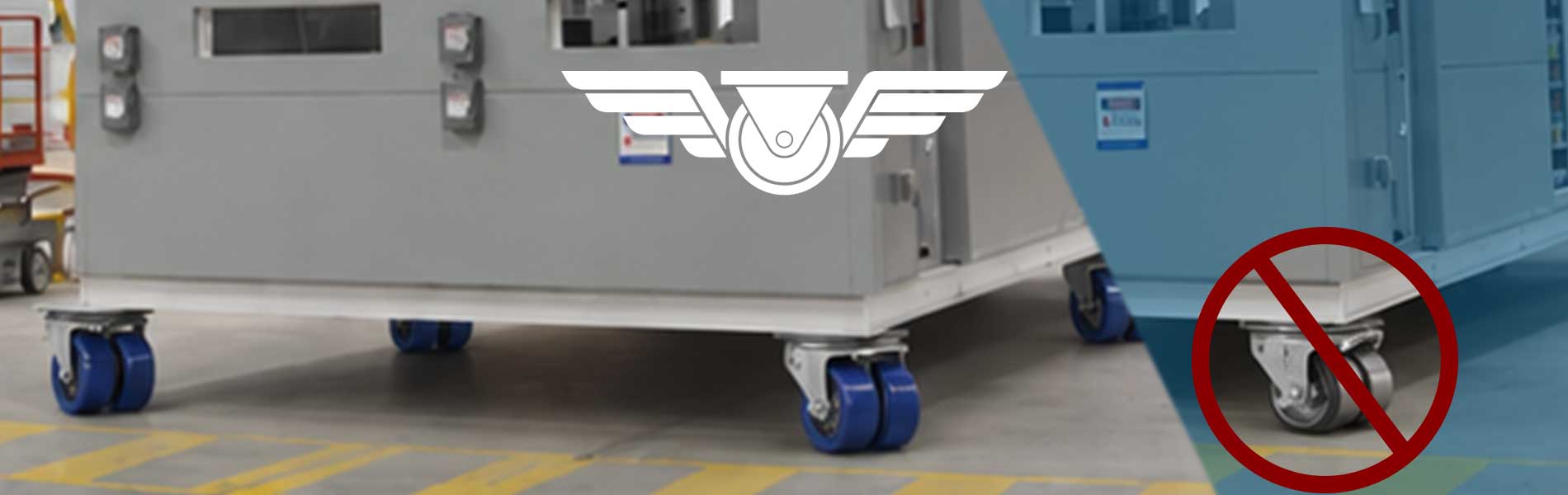
The Problem: A New Floor Destroyed in Less Than a Year
A power management company manufacturing prefabricated electrical rooms (e-houses) was experiencing severe concrete floor damage less than 12 months after installing a new facility floor. The culprit: 6x3 steel wheels on the heavy-duty carts used to move e-houses through the production facility.
Each completed e-house weighs tens of thousands of pounds. The carts carrying them ran on 8 dual-wheel casters 16 steel wheels total — bearing a combined load of 80,000 pounds across a standard poured concrete floor. Floor repairs were running close to $70,000 per year, and the damage was accelerating.
The facility contacted IAO Industries looking for a better option before investing further in a floor that was already failing.
Why Steel Wheels Destroy Concrete Floors
Steel wheels are designed for extreme loads and high-temperature environments — foundries, steel mills, furnace applications. On concrete, they are a floor destruction mechanism.
Three factors cause the damage:
Load concentration: Steel does not deform under load. The contact patch between a steel wheel and a concrete floor is extremely small, concentrating the full weight of the load into a fraction of the floor surface. At 80,000 pounds across 16 wheels, each wheel was bearing 5,000 pounds on a contact area measured in square inches.
Shock loading: Every time a loaded cart crosses a floor seam, a threshold, or an uneven surface transition, the impact transfers directly into the concrete with no absorption. Steel has zero compliance — there is no give in the wheel to absorb the energy. Over thousands of cart movements, those impact events fracture and pit the concrete surface.
Swivel scrub: When a swivel caster changes direction, the wheel scrubs laterally against the floor surface before aligning to the new direction of travel. A steel wheel doing this on concrete is essentially grinding the surface with each turn. At 80,000 pounds of load, the grinding force is significant.
Together, these three mechanisms explain why a concrete floor under steel wheels in a heavy manufacturing environment can fail in under a year.
The Solution: 6x3 Nylon Wheels ‚ Same Size, Dramatically Different Result
IAO Industries evaluated the application and recommended switching from steel to nylon wheels at the same 6x3 size. No change to the caster configuration, no change to the number of wheels, no modifications to the carts.
Nylon was the right material for this application for three reasons:
Load capacity: At 16 wheels bearing 80,000 pounds, each wheel carries 5,000 pounds. Nylon wheels at 6x3 carry this load comfortably without the floor damage characteristics of steel.
Floor protection: Nylon is significantly harder than polyurethane but far softer than steel. It distributes load across a larger contact patch than steel, reducing the pressure per square inch on the concrete surface. It does not scrub against concrete with the same abrasive force as steel during swivel changes.
Shock absorption: Nylon has enough compliance to absorb minor shock loads at floor transitions — not the vibration isolation of rubber, but meaningfully better than zero compliance steel.
The decision took two weeks from initial conversation to purchase order. IAO delivered the replacement wheels three weeks after receiving the order.
The Results: $60,000 in Annual Savings on a $48,000 Investment
Since switching to nylon wheels one year ago:
• Annual floor repair costs dropped from ~$70,000 to under $10,000 - a reduction of more than $60,000 per year
• Total investment in replacement wheels: $48,000 recovered in under 12 months
• Floor integrity maintained no structural damage requiring major repair in the first year under nylon wheels
The $48,000 wheel investment paid for itself in less than one year and continues to generate $60,000 in annual savings going forward.
Frequently Asked Questions
What caster wheel material should I use for heavy loads on concrete floors?
Nylon is the recommended wheel material for heavy loads on standard poured concrete. It provides high load capacity without the floor damage characteristics of steel wheels. Steel wheels concentrate load into a small contact patch and scrub against concrete during swivel changes, causing progressive floor fracturing and pitting. Nylon distributes load more effectively and has enough compliance to reduce shock loading impact on the floor surface.
How do I calculate the load rating needed per caster wheel?
Divide the total load by 3 when using a 4-caster configuration, or by 4.5 for a 6-caster configuration. For an 8-caster configuration with dual wheels (16 wheels total), divide the total load by the total number of wheels ‚ at 80,000 pounds across 16 wheels, each wheel must be rated for a minimum of 5,000 pounds. These calculations account for uneven load distribution and dynamic loading in real-world use.
Can steel caster wheels be replaced with nylon without changing the caster size or configuration?
In most applications, yes. Nylon wheels are available in the same dimensional sizes as steel wheels. If the nylon wheel at the existing diameter provides sufficient load capacity for the application ‚ accounting for the appropriate safety factor ‚ no change to the caster configuration is required. In this case study, 6x3 nylon wheels replaced 6x3 steel wheels with no other modifications to the carts or caster assemblies.
How quickly can IAO Industries source replacement caster wheels?
IAO typically delivers replacement caster wheels within 3 weeks of purchase order receipt for standard configurations. For hard-to-find or custom specifications, timelines vary based on sourcing requirements. Contact IAO at 517-798-4905 or sales@iaoind.com for a specific lead time on your application.
What are the signs that caster wheel material is causing floor damage?
Early indicators include progressive pitting or cracking in concrete along cart travel paths, visible grinding marks at turning points where swivel casters change direction, accelerating floor repair costs, and concrete dust accumulation along cart routes. If floor damage is concentrated along the paths where heavy carts travel and turn, wheel material and load concentration are the first variables to evaluate.

Ready to find out more?
IAO Industries engineers caster solutions for manufacturing, aerospace, heavy equipment, and defense applications. Contact us at 517-798-4905 or sales@iaoind.com to discuss your application.